


Two Weeks Driving a Tuktuk the Length of India
Updated: Jan 31
Driving India in a Rickshaw: The Rickshaw Run
We were craving adventure. A real challenge. Something outside our comfort zone and totally new. My mind went back nearly 20 years, to an idea I’d kicked around with friends: the Rickshaw Run in India.
The Adventurists bill it as “taking on the world in a glorified lawnmower” – which, in reality, means two weeks driving the length of India in an auto‑rickshaw. If you’ve been to Asia you’ll know these three‑wheeled machines: buzzing around cities, used as taxis, school buses, pick‑ups… it’s amazing what people can coax out of these tiny little engines.
The Rickshaw Run promises adventure, but not for the faint‑hearted. For all the light‑hearted humour on their website, they also give a stark warning: “Your chances of being seriously injured or dying as a result of taking part are high.” You can reduce the risk with sensible decisions and constant attention on the road, but the combination of road conditions, driving styles, and the laissez‑faire attitude of pedestrians and animals to road safety in India throws up plenty of “interesting” obstacles.
This is the story of driving a glorified lawnmower from Kochi in Kerala to Gangtok in Sikkim – 4,000 km in two weeks – and why it was one of the greatest adventures we’ve ever had.

At a Glance
Available runs: The Adventurists offer several rickshaw adventures each year – Sri Lanka, South India, “All India” (our route), and a Himalayan run.
Trip length:
Sri Lanka & South India: ~1 week
All India & Himalayas: ~2 weeks of driving. Allow a couple of days before for tuition and mechanics, and a couple more afterwards to rest and get back to your international departure airport.
Currency: Indian Rupee (INR) – cash is king in smaller towns, but ATMs are common in cities.
Language: Hindi and English widely spoken, with a rich mix of local languages and dialects along the way. A smile, a head wobble and the word “chai” go surprisingly far.
Budget level: Mid‑range overall. The rickshaw entry fee is the big outlay; day‑to‑day costs can be very affordable: local restaurants, basic guesthouses, and mechanic stops that rarely break the bank.
Visa info: Most nationalities will need a visa or e‑visa for India – always check the latest requirements before you book.
Overall vibe: Hot, noisy, slightly chaotic, endlessly welcoming, frequently ridiculous and utterly unforgettable.
Must‑See (and Must‑Survive) Moments
These are the standout places and phases from our run:
Kochi, Kerala – The starting line: tea‑fuelled nerves, decoration sessions and a big launch party with 50 other teams and the sound of rickshaw engines echoing around the yard.
Anamalai Tiger Reserve & Udumalaipettai – Breaking the “no night driving” rule on Day 1, puttering through tiger country in an open‑sided bean tin, rolling into town during lunar New Year celebrations of music, dancing and colour.
Araku Valley – Sweeping hillside views, cooler temperatures and winding roads through tea, fields and forest – a calm, green contrast to the plains below.
Bay of Bengal & Kotcherla Beach – First dip in the Bay of Bengal, stumbling into yet another local festival and becoming the centre of attention with our heavily adorned rickshaw.
Puri & Konark Sun Temple – Our “treat ourselves” anniversary stop: hotel pool dips in 48°C heat and a visit to the iconic chariot‑shaped Sun Temple nearby.
Bhitarkanika National Park – Boat safaris, lost rudders, crew jumping into croc‑filled water, and sightings of enormous saltwater crocodiles along the mangrove‑lined creeks.
Lataguri & Gorumara National Park – Jungle lodge, dawn jeep safaris, peacocks instead of elephants, and the biggest hailstorm we’ve ever experienced in a flimsy rickshaw.
Darjeeling & the Darjeeling Himalayan Railway (DHR) – Steep winding climbs, toy trains brushing past hillside houses, endless steps, tea, and jaw‑dropping views of Kanchenjunga on clear days.
Sikkim & the finish line in Gangtok – Horns blaring, music blasting, teams converging and 4,000 km of shared stories as we crossed the line feeling like our little rickshaw had become a third member of the team.

The Rickshaw Run Format
The Adventurists provide the rickshaw, the starting party, a loose finish line date and not much else. No set route, no support convoy – it’s you, your map (or phone), your wits and a glorified lawnmower.
Our run went from Kochi in Kerala up to Gangtok in Sikkim, crossing India from the Arabian Sea to the Bay of Bengal, then climbing into the eastern Himalayas. Kochi is wonderfully well connected; Gangtok, on the other hand, involves a five‑hour drive to the nearest airport, so getting home took a bit of planning.
Top Tips for Surviving
Check your start and end points carefully: A “funny‑looking line” on a map can mean very long travel days to and from the race.
Bike locks & straps: You’ll constantly be hopping out for markets, temples, meals and random detours; locking your bags to the frame and strapping everything down is worth its weight in gold.
Rechargeable speaker: Because any good road trip needs a soundtrack – especially one involving 4,000 km of rattling metal.
Power bank: You could navigate with paper maps, compass and sextant… or you could just keep your phone charged and focus on dodging cows instead.
Learning to Drive (in Five Minutes)
The Adventurists “set you up” for this otherwise self‑sufficient adventure with what can only be described as a very punchy driving lesson – about five minutes on how to operate this ridiculous machine. It’s actually easier than it looks, and by the end we were surprisingly adept at turning corners without tipping over and bullying the gearbox into neutral and reverse.
You also get a far more useful session on basic mechanics: pre‑departure checks (“Yep, still three wheels. Yep, only a small puddle of mystery fluid under the engine”), oil top‑ups and spark plug replacement. The main takeaway: autorickshaws are so common, and labour so affordable, that if anything goes wrong you’ll likely be surrounded by enthusiastic people wanting to fix it for you.
The crucial bit to understand is the fuel–oil mix for the two‑stroke engine; get it wrong and your plucky little lawnmower can quickly become a seized block of metal. We paid close attention to that part.

The Big Rules
Before we left, we came up with three simple rules:
Soak in as much as possible
If one person feels unsafe, you slow down
Never, under any circumstances, drive at night
Rules 1 and 2 are straightforward. In an open‑sided, petrol‑powered teapot you feel deeply connected to the world you’re passing through, and with a top speed that can generously be described as “optimistic”, slowing down isn’t exactly hard.
Rule 3… we broke on Day 1.
Day‑by‑Day (ish)
Coast to Coast
Our first objective: drive from the west coast to the east. We shot out of Kochi, full of energy, up through Kerala’s forest reserves and sweeping tea plantations. It was beautiful—until the rickshaw sputtered, coughed, and died going uphill during a heavy rainstorm.
We panicked.
We’d broken down within the first 200 km of a 4,000 km journey.
No. We’d just run out of fuel.
The tank holds roughly a thimble.
With that humility check complete, we continued our climb into the hills with nowhere to stay. Sunset came, and went, leaving us breaking rule 3. The only option was to continue—and “continue” meant driving through the Anamalai Tiger Reserve in an open‑sided rickshaw, at night. Equal parts thrilling and idiotic. We reached Udumalaipettai intact, immediately stumbling into Lunar New Year celebrations: dancing, drumming, colour, and several people determined to pull us into the festivities whether we understood what was happening or not.
Selfies also became a daily constant. You didn’t need to stop; locals simply pulled up beside you on motorbikes, matched your speed, and snapped away.
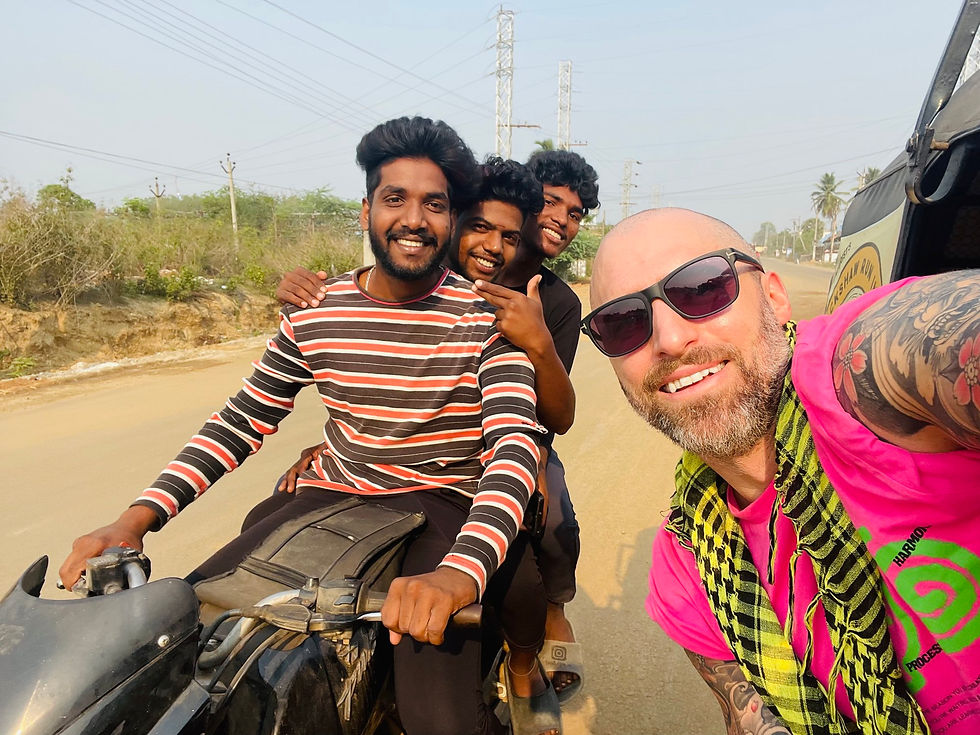
The days that followed were calmer but no less wonderful. South Indian hospitality is unmatched. The food—dosa, sambar, roadside parathas (dangerously moreish)—kept us fuelled and slightly thicker around the waist. And the temples we stumbled upon felt like secret treasures you’d never find on a normal holiday.
Early starts became our secret weapon: cool air, quieter roads, and more daylight to avoid rule‑breaking night drives. Moving north, we climbed into the Araku Valley, a lush highland region of forests, waterfalls, tribal communities and misty green slopes.
Feeling confident—overconfident—I decided to follow locals who were riding their motorbikes across a river. Lauren opted out. Sensible. I waded in with the rickshaw, successfully crossed, only to realise the track on the far side went nowhere. Turning back, the sun now glared straight at the water, making the return path invisible. One misstep and everything—bags, passports, dignity—would float away.
Lauren persuaded a local to demonstrate the route. I followed, heart pounding. We made it. Technically a success. Logically, a terrible idea. That was the final river‑crossing attempt of the trip.

The Bay of Bengal & Anniversary
After days of mountain roads, we descended to the coast and reached Kotcherla Beach — just in time for yet another festival. Once again, we became the attraction. Apparently two slightly sunburned westerners in a decorated rickshaw travelling 2,000 km is entertaining.
We planned something nicer for our wedding anniversary and chose Puri as a base. The Pramod Hotel felt like a five‑star resort after a week of grim sheets, mosquito fleets, and bathroom roulette. We visited the Konark sun temple, a vast 13th‑century stone chariot temple famed for intricate carvings and solar alignment.
Puri was beautiful but blisteringly hot—48°C and 99% humidity. Romance with a side of heatstroke.
The hotel staff shone when we needed rickshaw maintenance. They escorted us to a mechanic, negotiated fair prices, and even paid for a weld themselves, worried the locals might overcharge “the pale tourists.” Their kindness still stands out.
With humans and rickshaw refreshed, we set off again.

Bhitarkanika National Park
The next stop was Bhitarkanika National Park. A mangrove‑lined wildlife sanctuary known for giant saltwater crocodiles and dense waterways.
We booked a boat trip. Five minutes in: deer spotted, crocodile spotted, spirits high. Then the rudder fell off. We crashed into the riverbank and trees while the captain, unfazed by the 10‑ft croc we had just seen, donned a mask and leapt into the river to retrieve it. Hero. Madman. Maybe both.
Transferred to a new boat, we explored deeper into the mangroves, spotting more enormous crocs and visiting the remote Dangamala nature camp.
Into West Bengal
Heding ever further north we entered West Bengal. The cuisine shifted: fresh samosas, deep‑fried everything, and new flavours at every stop. Wanting more wildlife, we headed toward Lataguri in search of elephants in Gorumara National Park, a scenic grassland reserve home to elephants, bison, deer and rich birdlife.
Our 6 a.m. safari delivered an impressive… number of peacocks. Many peacocks. Only peacocks. Disappointed, we climbed back into the rickshaw, immediately driving into the largest hailstorm of our lives. Hail hammered the metal shell so violently it felt like sitting inside a steel drum being assaulted by gravel.

Darjeeling
The day needed to get better. Luckily it did. Our next stop was a big one – Darjeeling. A legendary hill station of tea estates, Buddhist monasteries, misty lanes and sweeping Himalayan panoramas, blending Indian, Nepali and Tibetan influences.
Reaching Darjeeling in a rickshaw is not straightforward. The gradients were so steep we occasionally jumped out and ran beside the rickshaw to lighten the load. Ridiculous. Memorable. Worth it.
Along the way, we crossed the tracks of the DHR (Darjeeling Himalayan Railway). A UNESCO‑listed narrow‑gauge “toy train” famed for engineering marvels and dramatic mountain switchbacks.
We spent two nights exploring—tea gardens, endless staircases, jaw‑dropping mountain views. On a clear day, we even caught fleeting glimpses of the distant Kanchenjunga range. Locals told us Everest is sometimes visible on crystal‑clear mornings.

The Final Ride to Gangtok
Darjeeling left us perfectly positioned: just 100 km from the finish. This was it – 2 weeks, 4000km, the two of us and our trusty rickshaw. This was the last day! We savored every grind of the gearbox, every splutter of the engine. The teams were converging and that helped to raise the energy, horns blaring, engines screaming, music playing, we finally crossed the finish line to the cheers of fellow rickshaw-runners who all had had their own fantastic stories of the last 2 weeks driving the length of this incredible country in what we now know is one of the greatest machines ever created.
Two weeks.
4,000 km.
One battered, beloved rickshaw.
Food & Drink
One of the joys of seeing India by rickshaw is how often you stop – for chai, for snacks, for fuel, for yet another person wanting a selfie – and with every stop comes food.
In the south we feasted on dosas, curries and endless cups of sweet chai, and fell hard for roadside parathas: delicious, buttery, flaky flatbreads that definitely didn’t help our waistlines.
As we moved into West Bengal, the food shifted towards fresh samosas and deep‑fried delicacies, perfect hand‑held fuel for long stretches behind the handlebars.
We tried to be sensible… but two weeks of “we’ve earned it” snacking is a powerful thing.

The Final Verdict
Well, we hope this has given just a small taste of what it’s like to drive across India in an auto‑rickshaw. But there’s only one way to truly know what it’s like – and that’s to do it.
It is not for the faint‑hearted. Days can be long, the ride uncomfortable, the heat unbearable. The anxiety of breakdowns will test your nerves, and you’ll occasionally wonder if your next meal is going to confine you to the bathroom for 24 hours. But that’s all part of the adventure.
And the auto‑rickshaw itself? We fell in love. What a machine. Completely inappropriate for such a journey – and yet, really, the only way to do it. It brings you closer to the journey, to the country, to the people and places. It brings so much joy to you as you coax this impossibly underpowered tin can on three wheels up mountains, and so much joy to locals watching you attempt it.
India is an incredible country: stunning landscapes, delicious food, and some of the friendliest people you’ll ever meet. Seeing it by rickshaw was a dream – one of those adventures that will fuel stories for the rest of our lives.


Comments